The Allergic March

Earlier this month I wrote about the ups and downs of peanut allergy diagnosis in our family. On one medical visit for my son Dexter's lingering cough,  the doctor used a term I had not heard before, but have since come to know well, "The Allergic March". The Allergic March refers to a cluster of allergy-related diseases that occur in childhood. These often occur in a typical se­quence, appearing early in life, continuing for many years, but often disappearing or lessening with age.

Here is an example of a typical sequence of Allergic March conditions  and symptoms. My son's Allergic March followed this typical pattern:

  1. Infant eczema
  2. Food allergy
  3. Environmental allergy and associated stuffy nose
  4. Childhood asthma
In our case, the infant eczema was not severe. It appeared simply as very dry, chapped skin. Now, at age 7, he still gets very dry wrists and hands in the winter, but my home remedy of olive oil and aloe seems to help.
I have already written about the food allergy and while we had been cautious about introducing nuts early because of a familial predisposition to food allergies, I am sure we did not expect that he would actually have an allergy.
The asthma was a surprise and took several months to diagnose at the age of 5.
Dex never had what I would characterize as an asthma attack. It was simply a lingering dry cough for several months that bothered him at night and upon any, and I mean ANY, physical exertion. For instance, a 10 minute walk to school would set off a cough every 10 seconds for a good hour.
On a vacation to Mexico, I finally clued in to the cough's duration and implications when I kept asking him to sit down for a minute until he stopped coughing. At one point in my life I suffered from exercise-induced asthma, and genius that I am, I had never made the connection between my post-exercise coughing asthma fits and his.
Treatment with inhaled-corticosteroids (flovent in the orange puffer), was effective within 2 weeks and he stayed on the medication until the end of that winter.
Since then, the asthma seems to only show up after he has a cold. That annoying cough comes back. We have explored various treatments with both our family doctor and our allergist. We were given the following therapies to consider:
1) Singulair - a once daily pill
2) Flovent (fluticasone: orange puffer) - an inhaled corticosteroid taken once-daily
3) Ventolin (salbutamol: blue puffer) - taken as needed up to 4 times per week, sometimes more during a cold.
We looked at the various options. Singulair, while not a steroid and good prevention, has some rare mood-altering side effects. Our son is moody on his best days and this slight risk was a strong deterrent for us.
Inhaled corticosteroids were effective for us, but studies have shown that long-term use of Flovent can cause statistically significant differences in height. My husband wants my son to play in the NBA (or at least the NBL), so growing to his full potential is important to us.

We have chosen option number 3. Dex uses his blue puffer (Ventolin) during a cold to prevent coughing and bronchial irritation. He uses it no more than four times a week before hockey games or practices where the cold plus the exercise is likely to set him off coughing. So far this year, we are happy with this course of action.

So, asthma under control for now, we now march on to the next issues: the anxiety associated with the food allergy and the recommended influenza immunization (flu shot) which will bring on an anxiety of its own. Stay tuned.
While this describes our family's account of asthma diagnosis, treatment, and management, every individual is different. Please consult with your family physician for any asthma or allergy-related concerns.
References:
  1. A Liu. The Allergic March of Childhood. Medical Scientific Update: The National Jewish Medical and Research Center. 2006; 23(1):1-7.
  2. The Canadian Lung Association
  3. BR Gordon. The allergic march: can we prevent allergies and asthma? Otolaryngol Clin North Am. 2011;44(3):765-77.
Liisa is mom to 2 boys, ages 5 and 7. She is a medical writer and a book lover. She blogs at FitforKid.net andLittleBookLovers.Wordpress.com.


Enhanced by Zemanta

Visiting the Vale Earth Gallery

By AndreaMy daughter and I had the opportunity to attend the newly renovated Vale Earth Gallery opening at The Canadian Museum of Nature in Ottawa. This Gallery is open to the public on November 30th but we had the chance to see it the day before.

Our family has been members of this museum for two years now. Having this membership is one of the best educational investments we’ve made for our children ages 8, 4 and 8 months. The child-friendly and interactive displays pertaining to natural history and natural sciences have lent a hand to school projects, personal interest and regularly satisfy the inquisitive minds of two of my three oldest children with their countless questions relating to our natural world.

I have to admit, I was a bit apprehensive when found out which exhibit was reopening. This particular exhibit was not one we visited regularly – not because it wasn’t well done, The Canadian Museum of Nature does not do anything poorly – but because it hadn’t appealed to the kids who were always with me. I’d enjoyed seeing the beautiful glass-encased minerals but just found myself imagining what beautiful earrings they’d have made.

That being said, I am not an expert on this or any topic of natural science. I am just a mom who wants to foster her children’s interests and provide them access to the information and experiences this museum has to offer.

My oldest daughter, Hannah, age 8, (aka. Nature Girl) has had a rock collection since she was two. I think every child has hunted for beautiful stones on a beach, a forest or a park at some point in their lives. I borrowed books to help identify these rocks but found the task of identifying and classifying minerals to be daunting.

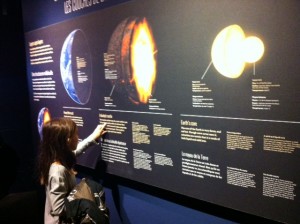
To my delight, I found this new exhibition helped fill gaps in our knowledge and understanding of mineralogy. Even better, my daughter was completely engaged in the displays and interactive features this permanent display has to offer. Fortunately when my children are engaged, I have time read and learn myself. The gallery starts at the beginning – literally. We read about the “big bang”, touched and examined meteorites that have fallen to earth and learned about the earth’s layers. She was particularly captivated by learning the consequences of a change in the solar system (ie. the absence of Jupiter or change in distance of between earth and the moon).

Around the corner she had the opportunity to control a 6-ft animated globe. She discovered how the plates divide and what the world would look like if the water evaporated.

This exhibition allowed us to see some of the most extraordinary mineral formations, some of which she has in her own personal collection. You have the opportunity to see an animation of how rocks and minerals form and what makes a mineral a mineral. A favourite highlight included the opportunity to view minerals under fluorescent light. You will be pleasantly surprised in what happens!

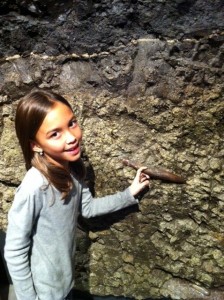
A compliment to the current Nature Unleashed temporary exhibit is an interactive opportunity to make a volcano or cause an earthquake. Visitors can also make different rocks with the Sedimentator (which makes sedimentary rock), Magmanator (makes magmatic rock) and the Metaporphicator (makes metamorphic rock). Another complimentary feature was the sedimentary rock face from Saskatchewan featuring embedded fossils. Children love to search for items – especially when they’re looking for a T-Rex’s tooth!

Hands down, the most popular part of the display was the replica of a limestone cave. The opportunity to be immersed into this realistic environment with dripping waterfalls and the challenge of identifying cave features and creatures was a great experience.

I feel this exhibition was designed with children in mind. The gallery used video, interactive consoles, comic strips, experiments, actual samples and simulated environments to engage children and their senses at their height level. I also feel it filled a huge hole in the museum’s content.

Every visit to this museum involved a mandatory “visit to the dinos!” but I suspect we’ll be adding a “visit to the rocks!” as well.

PS – Ok, I did find the earrings I’d like too! ;)

I am a wife and loving mom to three amazing children ages 8, 4 and 8 months, who continue to fascinate me with their inquiring minds and desire to discover. I learn through them.

Enhanced by Zemanta

Giving Back at the Holidays

by Krista As my family prepares for the holiday season, we have decided to once again make a concentrated effort on helping to support those in our community who are less fortunate, and want to involve the lils as much as possible.  We feel that it is important that they see us trying to help those who are less fortunate than we are, teaching them to be giving and empathetic.  We are very thankful for our happiness, health, and home, and we know that others are not as fortunate.  We want to show our children that we together can do something to help.  I remember doing that with my parents when I was young, and I hope my children will grow up to remember the same.

Here is a list of a few of the ideas that we have participated in the past, or investigated for this year.  Some represent a monetary donation, a donation of time, and some require both. Not all are applicable for families with young children, but I am going to try and get them involved in as many as possible! I’ve noted age limits or restrictions where I could, but it is always best to check with the recipient of your donation to see what age is appropriate for participation.  Some will encourage the participation of little ones, but others might require that they be excluded or take a limited role.

The Ottawa Foodbank is a local institution that helps to feed families in need, as well as supply food to shelters and other programs for their meals.  I am sure that you have seen the bins in many large grocery stores in the area.  This month, we will be targeting their “most needed list” with a donation each time we shop.  I also looked into whether we could volunteer in any capacity, but our children are too young.  If you do have children 6 or older, you can volunteer together to do things like work in the warehouse, do office work, or work at special events. The volunteer contact information is on their website.

The Christmas Exchange also seeks to provide assistance with feeding families in need, through the Christmas hamper and store vouchers programs.  When I was a child, we used to always do Christmas baking while listening to their Christmas Cheer radio-thon on CFRA.  This year’s Christmas Cheer broadcast was held on December 6th  (and has always been one of my favourites), but they have many other opportunities and events for our family to get involved listed on their site.  While it is possible for children as young as five to volunteer, there are only volunteer activities for those eighteen and older listed on the volunteer page. Contacting them directly may yield more opportunities for younger children.

The Shepherds of Good Hope as well as some local churches and houses of worship (many of Ottawa’s houses of worship are listed here) also have programs where you can “adopt” a family, and build a hamper containing food for Christmas dinner, essential goods and small gifts. You can see if your family can help to build a hamper by purchasing the items they need, pack hampers and wrap gifts, or deliver hampers right before Christmas.  The Shepherds of Good Hope has expressed that they are in great need of people to sponsor families, having had many more requests this year than they would normally fill.  When you call, you can be matched to a family that is in great need, but that meets your wishes (ie size or location).  You then contact the family representative and discuss what their needs AND wishes are.  There are opportunities for younger children to help out in all aspects of this process, but some tasks may be more suitable than others, so please remember to let whichever organization you help out with know that the ages of your children so that you can ensure they will help out when they are volunteering.

Many local elementary, middle, and high schools, churches, and community associations also get involved with food drives, charitable fundraisers like bake sales and holiday meals.  These drives and events provide a great opportunity to talk about those less fortunate, and why you support the activities.  You can help out by volunteering with your child in preparation for the event, gathering donations, baking, cooking, or helping out at the event.  School, church, and community run events generally offer great opportunities for children of ALL ages to help out. Please check with your local school, community association, of church to see what they have planned.

There are a few institutions in Ottawa that host holiday meals in the days leading up to Christmas, starting as early as this weekend! The Mission is one that holds the meal in advance of Christmas December 16th for this year’s meal. This presents an opportunity for those looking to volunteer, but not on Christmas day.  In addition to using volunteers on that day, they have an ongoing need throughout the month.  Youths aged fourteen and up are eligible to help out with their parents at the Mission or their events.  If your children are too young, they may still have a need for prepared foods, that you can make together.  My lils and I are baking cupcakes through Cupcakes 4 Christmas again this year, our contribution to the dessert at this meal.  Please contact either of these organizations directly to see if they have further need.

A number of local restaurants and houses of worship also hold free meals for those less fortunate on Christmas day.  The Newport Restaurant in Westboro is one such establishment.  They have been hosting a Christmas meal for as long as I can remember and accept all sorts of food donations, as well as need volunteers on Christmas day to help out.  The best part?  They accept volunteers of all ages!  When I called to ask what we can do to help, they told me that young children are welcome to help out, provided they can carry a plate! If you cannot make it on Christmas day, they also accept food donations in advance.  Please contact them directly to see how you can help out.

In the lead up to Christmas, we will also try to bring some toys to children in need. This can be accomplished in a couple of ways. One idea that I had was to go shopping as a family and pick out toys or games that our children would like, but donate them to Toy Mountain, which only accepts new toys.  The other was to clean out our toy bins, and donate the toys and books that we don’t use any more to a shelter (the Community Information Centre of Ottawa has a searchable database to help find shelters), or church, or a thrift store.  Thrift stores, like Value Village take all sorts of donated goods, including toys, and help out lower income families by offering them for sale at low cost.

Finally, we will be gathering up our old snow suits to donate to the Snowsuit Fund, which will pass them on to children in need.  The children can help us with this task by gathering the pieces and matching up hats, mitts and boots, and then dropping them off with us.

December is a busy month, and I know that we are not going to be able to do all of the ideas that I listed above, but I hope to involve the children in some of the ones that we have planned.  I know that not everyone celebrates the holidays in the same way, or at the same time, but I hope these activities give you a starting off point if you are looking to help out in the community. Looking for other ideas? The Community Information Centre of Ottawa has compiled a GREAT list of events that are going on over the next few weeks in support of those in need, a list that highlights donations needed and how individuals can help.

Do you have any other ideas?

Krista is married to Willy and mom to a 5 year old son, Woo, and 4 year old daughter Goose. You can find her at Life in the Hutch or on Twitter @kgraydonald

Enhanced by Zemanta

Diagnosing a Peanut Allergy: One Family's Story

by Liisa It could be worse. That has been my mantra when it comes to my older son's possibly life-threatening, always manageable, but oh-so-annoying health conditions.

Before I get into the meat of my story, let me introduce myself – I'm Liisa. I'm the mother of two boys, ages 5 and 7. I am thrilled to be able to contribute to Kids in Capital on health and medical topics. In the spirit of this blog, I am going to make things personal, taking you on our family's journey to stay healthy and happy.

Part 1

In the summer of 2008, my three-year old son vomited immediately following a bite of his first-ever peanut butter cookie. We had kept him nut-free until then. My husband has an allergy to cashews and the doctor had advised us to wait until his third birthday.

We were referred to an allergist by our family doctor. Three months later, during a gruelling afternoon wherein the skin scratch test showed very little, but the blood test showed something more, we would learn that my son had a peanut allergy (and my little son would learn that sometimes moms lie (“it's not going to hurt much, just put your arm out”).

We were told that his levels of IgE were low and there was a good chance he would grow out of this allergy. We could retest in a year. If the test was still positive with low IgE, he could go on to do a food challenge (i.e. eat peanuts and see what happens). In the meantime, we were to carry epi-pens for him, avoid ALL nuts and traces of nuts and maintain a nut-free home.  You never know whether the next reaction could be an anaphylactic one with peanuts.

Part 2

Eighteen months later it was time for the next allergy test (on April Fool’s Day no less).  Much googling for journal articles on diagnosis of peanut allergies in children gave me hope.  We had experienced no further reactions. I looked forward to the results and to good news.

My son did not look forward to the appointment the way I did. He was convincing in his argument that testing was not necessary since he did not care for peanuts and nuts, and would not need to eat them now or in the future.

We prepared well for our trip to the allergist. My husband and I were both there for extra distraction and mutual moral support; we brought a treat for morning snack, and a promise of a toy store visit after the appointment.

The good news: We didn’t have to go for a blood test - what a relief.

The bad news: As we sat and read stories for 15 minutes, we glanced periodically at our son's arm. It was clear that the second “P” (indicating peanuts) on his arm was lighting up with a nice hive, a 6mm hive to be precise.

At that point we were, and would likely remain, a nut-free family. Our younger son, then 3, would also be tested as there is an increased likelihood of peanut allergy in siblings of allergic children.

We were glad to know where we stood, glad it was peanuts, an allergen that is common and simple to manage in North America. It could be worse!

Our allergist answered some of our questions and gave us some tips:

1) He recommended getting a Medicalert bracelet. We did though it was tough getting him to keep it on. We found disposable bracelets from Mabel's Labels that he was happy to wear when he was at birthday parties or occasions when his family was not with him.

2) We could eat at restaurants as long as we asked about the food; if a restaurant gave us the “we can't guarantee” speech, we must be absolutely sure we had an epi-pen with us.

3)  Though he was not allergic, almond butter (even with the peanut-free label), was not okay.  This would be too confusing for him and for others.  We should keep it simple and say absolutely no nuts or nut products.

4) We should go back in a year to test again.

Part 3

Late 2011: My son was now 6 years old. We visited the allergist again for the third round of testing in 3 years. The continued absence of reactions gave me hope that perhaps there was no more allergy.

We grabbed his Star Wars sticker book and off we went.

After a brief consultation, we went into the exam room for the drops and scratches, which this time would include environmental allergies. Shortly after the nurse left the room, my son began to feel uncomfortable itching in his arm:

  • He reacted strongly to cats. We don’t have a cat. No biggie.
  • He reacted to peanuts, not strongly but still significantly.

This time medical science had something new for us – a blood test (privately funded at $180) that can type an allergy to predict the likelihood of a systemic (i.e. anaphylactic) reaction. The test isolates the different types of protein in the peanut and the reaction to each.

In studies, there are certain proteins which have little association with anaphylactic reactions and certain proteins which have strong associations with anaphylactic reactions.

If there was no reaction to those proteins with the strong association to anaphylaxis, we could move to a food challenge.

Hope!

I hypothesized that he hadn’t had any reactions because he had the mild type of allergy, and now we could identify it.

Two weeks later the call from the allergist’s nurse came…He only reacted to one protein, the one to which 90% of those who have had anaphylactic reactions were positive.

[Insert expletive]

We had been doing a good job of keeping him nut-free and would continue to do so.

It could be worse!

Epilogue

My younger son was tested and has no allergies. He enjoys nutty treats when we are out of the house and away from his big brother.

My husband and I continue to go on “peanut dates” which include Vietnamese food with oodles of peanuts and peanut sauce, followed by a movie wherein we consume peanut M&Ms like they are about to be discontinued.

We are due to return for testing this month. I have put it on hold to deal with other more pressing concerns, but it will be done sometime in early 2013. The allergy diagnosis was just the beginning of what I have now learned is called “the allergic march”. In future posts I will describe the asthma and anxiety that followed.

If you suspect a food allergy in your child, talk to your family doctor. Only a medical doctor can diagnose an allergy. Diagnosis includes a patient history, skin prick test, and possibly a blood test and/or food challenge test.

References and Resources

Anaphalaxis Canada anaphylaxis.ca

Allergy/Asthma Information Association  www.aaia.ca

Allergy Safe Communities www.allergysafecommunities.ca

CSACI (Canadian Society of Allergy & Clinical Immunology) www.csaci.ca

CAAIF (Canadian Allergy, A

sthma & Immunology Foundation) www.allergyfoundation.ca

Ontario’s Sabrina’s Law www.ontla.on.ca/web/bills/bills_detail.do?locale=en&BillID=135&isCurrent=false&ParlSessionID=38:1

The Complete Peanut Allergy Handbook by Dr. Scott Sicherer (available through online retailers)

Liisa is mom to 2 boys, ages 5 and 7. She is a medical writer and a book lover. She blogs at FitforKid.net andLittleBookLovers.Wordpress.com.

Enhanced by Zemanta

Letters to Santa

Did you know the City of Ottawa Archives has events and workshops for kids?

Most people think of the Archives as a place for adults and academics but the staff at the archives is trying to change that. We want kids and their family to know that we are not just trying to preserve the memories of the City of Ottawa and the broader community, but trying to encourage and teach everyone how to do this for their own families.

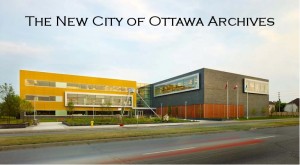
In 2011 the archives moved to a brand new building, at 100 Tallwood drive, which provided the space for us to expand our programs and services.

We are now having our first holiday event.  Come to the archives and write your letter to Santa on December 2nd, 2012 from 10 am to 3 pm. The kids can also make crafts, decorate cookies and enjoy some holiday stories.  Bring the entire family. It’s free.

For more information about our programs look us up at ottawa.ca/archives or like us on Facebook.

Enhanced by Zemanta