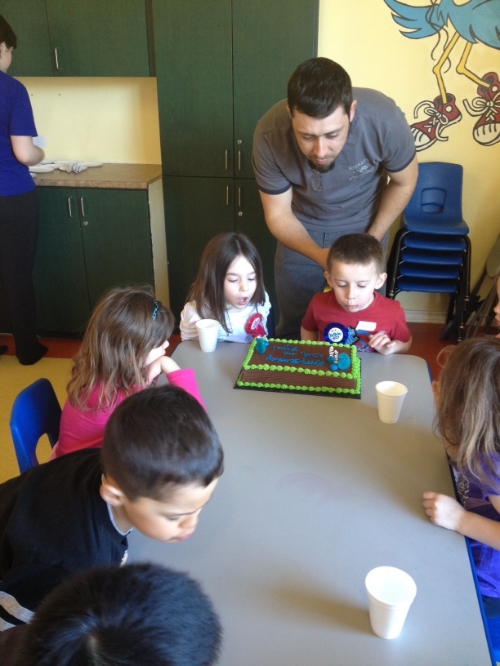
Welcome to the Centre for Child Language Research!

We're very happy to welcome our new blog sponsor, The Centre for Child Language Research. As a health researcher by day, I can't stress how important it is to participate in research when we get the opportunity. And plus, who doesn't enjoy a fun, free activity for the kids? 

By Stephanie, Lab Coordinator

Are you looking for a fun new activity to do with your kids? Come visit the Centre for Child Language Research! The CCLR is a language development lab on the University of Ottawa campus that studies how your child learns language. We run studies for children from 2 years old all the way up to 8 years!

Our lab space is a welcoming environment for children with lots of books and toys for them to play with. A typical visit lasts just under an hour, with the actual studies  being between five and fifteen minutes. Parents are also able to park for free while they are here! Our experiments are designed to be fun and engaging for children. In fact, research in our lab has found that using elements from video games helps children to perform tasks more easily. To find out more about a typical visit, check out this first-hand account from when Kids in the Capital visited one of our partner labs on campus.
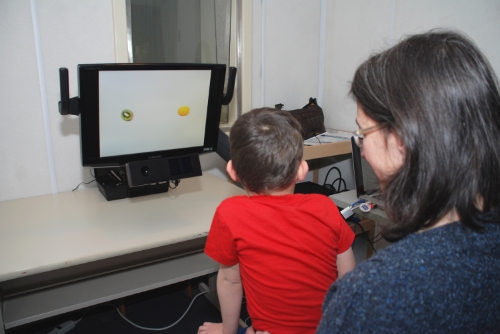
Experiments that are fun and interactive!

Experiments that are fun and interactive!

A lot of the research we do is focused on discovering how children learn the sounds and words of their language, and how children become so amazing at language within the first years of their lives. One of the ways we ask these questions is by looking at how language experience influences the speed and accuracy of children’s ability to name pictures. For example, are 3-year-olds faster to name a picture of a book (a word that starts with ‘b’, which is learned at a very young age) compared to a picture of a shoe (a word that starts with ‘sh’ which is usually learned later). We also look at how children to learn brand new words. For example, when a child hears a new word, is it beneficial for them to repeat it out loud? This is similar to learning a new language in the classroom when a teacher pronounces the new words and the students repeat them. Our results show that sometimes it helps to repeat the words, but in cases when children are learning something very difficult, repetition might not always help! 

We also look at how children perceive the language they hear. When we speak, the individual sounds of a word are not easily separated like you see in writing. Instead, they all start to blend together and change depending on the sounds around them. For example, say the word ‘key’ out loud, focusing on where your tongue hits the top of your mouth during the ‘c’. Compare that with the ‘c’ in ‘Coke’. The slight differences in the place where your tongue touches the roof of your mouth lead to differences in the acoustic signal that you hear. Adults can pick up on these miniscule differences and use them to identify a word without waiting to hear the whole thing. We are now discovering whether children can do this too.

The research at the CCLR is integral to our understanding of language development. This leads to better practices in education and in treating children with language disorders or delays. Parents can happily bring their children to our lab knowing that this research benefits society.
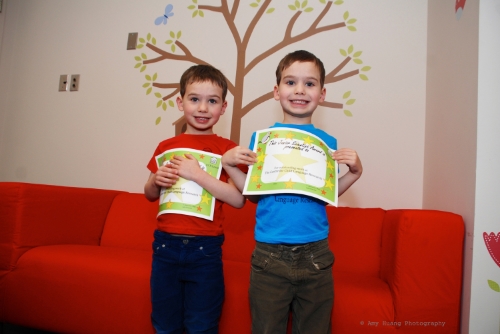
Junior Scientist!

Junior Scientist!

Children who help us out with our research get a Junior Scientist Award  and a t-shirt or small gift to take home! Participating with us is a fun, educational, and free activity that can be scheduled all year round. If you are interested, please sign up using our online form!  You can also check us out on Facebook


Kids and social media

I've been invited to appear on CTV Morning Live this morning to talk about kids and social media. I decided that I'd put some of what I'm going to talk about into a blog post and would love your thoughts and opinions on the subject in the comments.

**

It's hard to avoid social media in this day and age but when should kids start getting involved? Should you be letting your kids have Facebook, Instagram or Twitter accounts?

Terms of Services

The first thing to note is that almost every single social network requires anyone who signs up to be at least 13. This is because of the Children's Online Privacy Protection Act in the US which won't allow private information to be obtained from children.  Because that's what most of the social networks are actually doing, it's easier for them to simply not allow children under 13 on to their sites.

If you make your decision based solely on the actual rules, your children shouldn't be on any of these sites if they're under 13.

What if you want to let them anyways?

I personally am a fan of giving my children a lot of knowledge. A lot of parents don't think kids under 13 should be allowed on social sites because they aren't mature enough and others believe that the rules are the rules and you shouldn't break them. I don't agree with breaking the rules in general but I also want to raise children who learned from a young age what it means to be online. My eight and a half year old has a Facebook account, but he has very little access to it and it's very supervised (he mostly uses it to play occasional Facebook games or to post a few photos to his small network). 

Rules and Regulations

As such, I think it's very important, at whatever age you're starting your kids online to have a lot of rules and discussions.  The rules I recommend are:

- A parent must always have access to all passwords. If passwords aren't working or have been changed, access to internet and devices is removed. (In our house because my son is only 8, he doesn't even know his passwords, if he wants to do something online someone needs to log him in.)

- Don't expect any privacy online. It's not a private place and as a parent we are responsible for them and their actions. This means they can be spot checked at any time by us logging in and going through what they've been up to. They also must let us be connected to them on all channels.

- Privacy settings must be set up by a parent and aren't to be changed.

Discussions

Before kids go online there are a lot of important discussions that need to happen. Both of these topics are actually deserving of entire posts on their own.

Privacy: Don't share personal information online. Your kids need to understand this and why. First and foremost, it's for their safety.

Cyberbullying: It's easy to be mean online. Teaching your kids empathy and the importance of being kind online is critical and an important discussion to have before your kids start spending time on social sites.

Model good behaviour

The best way to teach your kids what appropriate online behaviour is is to model it yourself. Don't share inappropriate content online,  ask your children if they mind having information about them shared online before you share it, be respectful of others and always remember how permanent the internet is. I often show my kids what I do online so they can see what it's all about.

Where should they start?

Regardless of what age you start your kids on social sites at (before 13 or not) a great way to start is with a closed network. Facebook, Twitter and Instagram are all examples of networks that allow you to keep your information in a private setting and that's a great way to create a safer environment for your kids to experiment in. 

For more information there are a lot of great resources on Common Sense Media including a post on what a good age to get started is.

This was just a quick overview and we can go into much more depth on a lot of the subjects. If there's anything in particular you want to know more about - let me know!

I know this can be a hot topic so please share your comments (respectfully of course :) below.

Worth a Visit: A Gym Tale

by Andrea

Every year, my twins would celebrate their joint birthday celebration at my parents’ house. It was always just family, and being born in March, it was never guaranteed that backyard play would be included. This year, we decided to try something different, and chose to host the party at A Gym Tale in Barrhaven.

At A Gym Tale, you can host different themed parties. We chose a pirate theme for my son, Seth, and a mermaid theme for my daughter, Rayna. I didn’t really see much of a theme at the party, though they did gear some of their private play games toward pirates (maybe I wasn’t paying that close attention, but I have no recollection of any mermaids. I will chalk that up to it being a double party and the boys were far more rambunctious).

For $169, you can invite eight children, with thirty minutes play in the indoor playground, another thirty minutes in the private themed area, and one hour in the private party room where lunch is served (hot dogs or pizza). You have to bring your own cake, but the staff will serve it.

The staff are VERY patient and knowledgeable. As the parent, however, you are in charge of making sure that the group behaves. That aspect can be a little trying, as it is a very busy place and children just love to scream. It was a little chaotic in the beginning with kids trickling in, but everything was sorted out once everyone arrived. Normally with a jungle gym atmosphere, you might encounter some nasty mystery puddles, but I found the place to be very clean. 

The climbers are part of a big pirate ship, complete with slides and multi-level play structures. The private play area is in the centre of the place, fenced off with crash mats, a trampoline, and plenty of things to play with. I’ll admit the kids would have preferred to have played on the structures, but they still had fun in the private play area. After the kids were done in there, we were brought to the private party room to enjoy a slice of pizza, some lemonade, and finally, cake. 

We all had a very good time! You can also check out A Gym Tale's drop-in playtime, special “Kids Night Out”  events, as well as nursery school and school-age care. This place is perfect for children ages 6 and under, and I would recommend it for your little one’s party - especially if they have a lot of energy to burn! 

Andrea is a freelance writer and mom of twins, and resides in Barrhaven.

Indian Food Kids Will Eat

I realize there are probably kids out there who will gobble up spicy chana masala or matar paneer. But despite showing early enthusiasm for Indian cuisine (it might have helped that I ate it every day while pregnant), my girls started rejecting these yummy dishes around age two. The spiciness factor is certainly an issue for some kids, while I think general toddler pickiness plays a big part.

So here is my "go to" Indian recipe for when I'm really craving all those gorgeous spices - and surprisingly, my kids love it! (It may help that we often order naan bread from the Indian restaurant down the road to go with the meal).

Kiddy Curry

2 tbsp coconut oil
1 small onion, chopped (or if your kids hate onions, just use onion powder!)
2 cloves garlic, minced
1-inch piece of ginger, minced (or half tsp dried ginger)
3 medium sweet potatoes, peeled and chopped
2 tbsp curry powder (I love Cardomom and Cloves for fresh, tasty mixes)
1/2 tsp cumin, ground
1/2 tsp ground coriander
Salt and pepper to taste
1.5 cups chicken or veggie stock
1/4 cup ground almonds (almond flour)
2 apples, peeled and chopped
1 cup frozen peas

Garnishes: greek yogurt, chopped fresh cilantro, SPICE (this one's important, as I don't spice the dish before I serve it to the kids. I add my own spiciness!)

Heat the coconut oil, and saute the onion, garlic and ginger for five minutes. Add the chopped potatoes and spices and mix to coat. Pour in the stock (you may need slightly more than 1.5 cups or slightly less - you don't want it too runny!). Add the almond flour, and bring it to a boil. Lower the heat and add the apples. Simmer until the potatoes are tender, and then mix in the frozen peas. Give it a taste, and see if it needs any more curry powder, coriander, salt, whatever!

Serve over a bed of rice. I also make raita (a yogurt dip) to go with this.

Tip: sometimes I make this dish too runny. If it ends up like that, I will mix 1 tbsp of arrowroot flour (or corn starch) with 1 tbsp water, and pour it in. This will thicken it up to a curried consistency.

Do your kids enjoy Indian food?
 

Connecting with your daughter: Mother/Daughter Journals

by Donna

I’m a mom of two little girls, 6 and 8. I was very close to my mom, and I hope to share a similar relationship with my girls. I read about Mother/Daughter journals somewhere online a while back, and the concept really appealed to me. As an historian by training, the thought of having a record of communication between my girls and I was instantly attractive. Also, as someone whose own mom passed away too soon, I would love to have such a keepsake.  So, one day at Chapters last summer I picked up a few pretty paper journals and tucked them away. I decided to pull one out this fall and wrote my daughter a short letter, and tucked it under her pillow.  I explained to my daughter that she could write back when she wanted, and could leave it in under my pillow for me to find.

My daughter seemed rather tickled about the process.  She asked me lots of questions: “Can I write about anything I want?” (Yes!); “Can I write whenever I want?” (Take your time!); “Do I have to tell you my secrets? (Only if you want to!); “Should I tell my sister?” (Let’s keep this between the two of us. She’ll get a journal when she’s older).

And then I waited.

And waited.

Weeks, a month rolled by. But one night, my husband and I went out for an evening. When I came up to bed, I noticed the journal peeking out. I was thrilled.  (I may have cried!) It worked. The journal has gone back and forth several times now, and my youngest asked last month if she could have one of her own (her older sister broke one day and spilled the beans). Entries from my youngest have been pretty basic as her literacy skills are still pretty rudimentary – but what great incentive to read and write! While the entries by my oldest have been mostly focused on discussions of Harry Potter, it is my hope that:

  • The journal will provide a space to talk about potentially difficult topics.
  • The journal will  let me into their quirky little minds (this is already happening – their observations of things make me smile)
  • Writing in a journal will give them an opportunity to ask me questions about myself (how I wish I had the opportunity to do so with my own mom)
  • ·We’ll have fun and strengthen our bond.

I wrote about the mother daughter journal concept in a facebook comment and it sparked a fair bit of interest. I’m eager to keep at it and see where it takes my girls and I. Maybe you’ll give it a try!

Let us know in the comments if you'd try anything like this or if you will!