Transcript of the interview:
SUMMARY KEYWORDS
growing pains, muscles, hurt, kids, knee injury, tight, bone, happening, cringe, hips, child, ankle, pelvis, legs, physios, treat, pain, puberty, compensate, injury
SPEAKERS
Marie Shinmoto, Lara Wellman
Lara Wellman 00:00
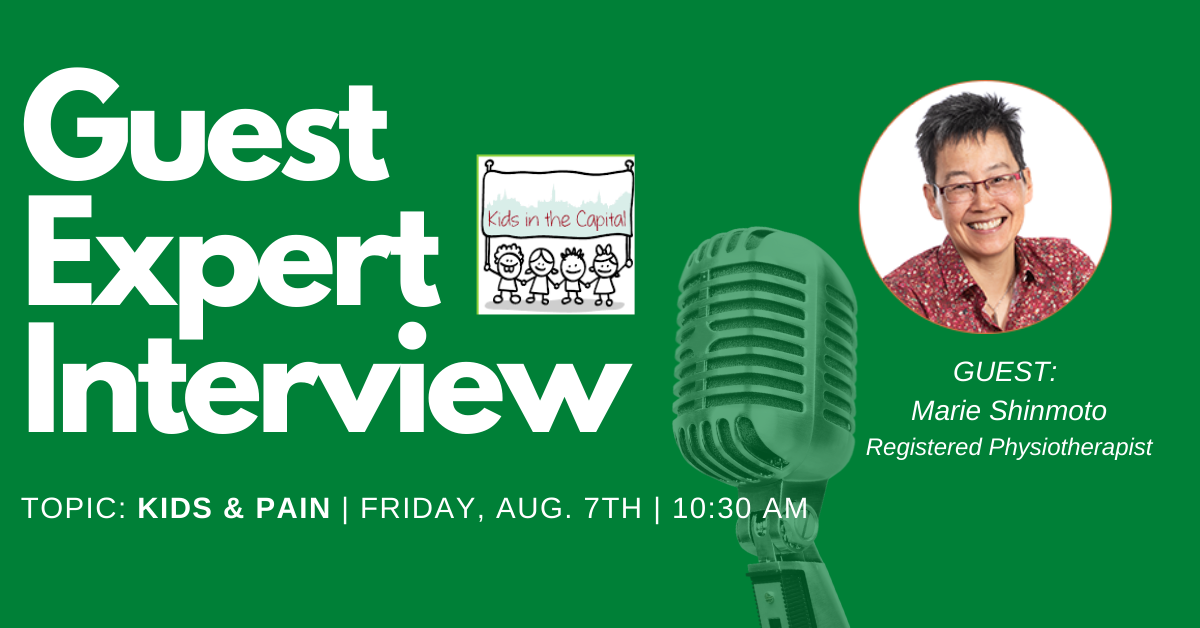
Good morning, everybody. I am Lara Wellman. I am the owner of Kids in the Capital and today we are doing another one of our expert interviews where we invite different experts who deal with kids to come and join us here in our Facebook group. We put it up on the blog later on and we talk about things that we know parents can really use the information about. So I am going to double check that this is actually working over and we are live and I am going to get Marie who is a physiotherapist to introduce herself - tell everybody who you are, what it is that you do. And then we're going to talk about kids and pain, in a good way.
Marie Shinmoto 00:46
My name is Marie Shinmoto. I'm a physiotherapist I've been practicing for 30 years. I'm old. I am the owner of M.A.P. physiotherapy which is in Orleans. And I worked the first 10 years of my career at the Children's Hospital of Eastern Ontario. And I wouldn't trade that experience for anything. I learned tons working there about not just about kids, but about medicine in general. And then I moved into private practice. And I've had my own practice for 12 years now.
Lara Wellman 01:20
Excellent. So I wanted to have you on because I've known you for a while you have helped my kids with different things that are going on with them. And you and I've had a lot of conversations that I think are interesting, and that are the kinds of things that I think parents would be interested in learning about things about kids and their pain and the things that people think about pain and the things that people can do to take care of all of that with this big thing around kids. So why don't I just let you take that part away? What is it that you see about how parents think about pain when it comes to their kids.
Marie Shinmoto 02:04
I think one of the biggest, most common things I see is we expect kids hurt themselves. And we think they're just going to bounce back. You know, they're not like us old folk. We fall down and we can't get up and it hurts for three weeks. And so kids do tend to do that they they have this massive Wipeout at hockey or soccer on their bike and, and they have, you know, some bruises and we dust them off and off, they go and they go - they're just fine. Well, sometimes they are and sometimes they're not, so and I think the key is knowing when to seek help and when it really is just a bruise.
Lara Wellman 02:42
Right, because that's one of the conversations you and I have had "kids bounce back", but then they haven't actually bounced back. They've sort of compensated in some way and now they have a new problem that's going to be there ongoing.
Marie Shinmoto 02:57
Exactly. So let's say your kids is playing soccer and goes flying over another player and takes a huge tumble. And they might hurt for a couple days and then it stops hurting. So we think they're fine. But what happens sometimes is that their bodies are more adaptable sometimes than ours. And so they find a way to work around the issue. So let's say if they fell really hard on their back and their back muscles are really tight. They will just over stretch some other parts so that that tight part stops hurting. But that tight part stays tight. They're working around it, it stops hurting, but then you know, the next week they crash into somebody, rollerblading, or whatever it is, and they hurt for a couple days and then they seem fine, but these things have a cumulative effect. And then sometimes it seems like they'll start complaining of pain out of the blue but it's really because those previous incidents haven't been dealt with. So kids are a lot better at working around an injury than we are.
Lara Wellman 04:10
So how do we know when to come in and see you? Do we go see the doctor first? What is it that we need to be looking for? And how do we actively make sure that we're not just ignoring something that should need attention?
Marie Shinmoto 04:25
One of the things I talk about is called the cringe test. If you're watching your child playing outdoors, and they're running in the grass, and they fall on their knees and you think "they're fine" then they probably are. But if you're watching them play some kind of sport, say hockey, and they have this horrible wipe out and they just go slamming into the boards and you cringe, you probably should get checked out. T That's a simple easy thing. We all know what we're talking about here, right? That cringe. The times you think "That's gotta hurt". So if you've done the big cringe and if everybody's done the big cringe then, even if the child after a couple days says I'm fine, they're probably not. So that's an easy thing. cringe test. But the point that the important thing is, they might hurt for a couple days and then they say they stop hurting, but they're probably not okay.
Lara Wellman 05:55
Because kids don't actually just bounce back.
Marie Shinmoto 05:58
No. That tightness stays In their bodies, so if you saw your kid go smashing into the boards you cringed. and you think "oh you'll be fine in a couple of days", but if you saw, say somebody who was 55 running on the street and just do a BAM a faceplant, you'd be like, "Oh, you need to go get some help, right?" So kids just cheat more efficiently than we do and cover it up and seem okay faster than us older folk. But they get just as tight when things fall and they they compensate around just as much and we will all pay for that at some point down the road.
Lara Wellman 06:39
Right, which is the big message that I've gotten from you over the years is that some of the reasons that older bodies hurt all the time is not is not just because we're old. It's because of all these things that have piled up for a bunch of years.
Marie Shinmoto 06:53
Exactly. I mean, you know, it's like, oh, "I'm getting old, I should hurt" Well, it's not age itself that should be painful, it's the fact that the longer we're on this planet, the more of these cumulative traumas take effect that have never been properly treated. And you get tight here, tight there, compensate around that, compensat around that, until you run out of ability to compensate. And then things really go sideways. And then people come in and they're like, no, this hurts. And this hurts. This hurts. And this hurts. It's like, Well, of course, it'll hurt. Because you've been spending, you know, what, however many years, 40 years or 50 years, compensating around stuff that's happened to you. So investing now in your children, when they hurt themselves, will pay off when they're in their 40s and 50s.
Lara Wellman 07:40
Yeah, because when you're working with adults, I know you can find all these things that are rooted back in childhood. "Oh, you've been doing this for a long time - we can fix that now." And that's a big reason that I and I bring my kids to see Marie because that's an important piece for me right now. I know how much my body hurts now and if we can avoid any of those things by working on them now so that they don't build up, then that's a good thing.
Marie Shinmoto 08:11
Yeah. But to really see that connection from a childhood injury to something that's bothering you in your 40s you have to look at the whole body and how everything is interconnected. Not just the bit that hurts. I have a client who skis competitively and had as a child like some terrible tumbles, like in the cartoons where you know, it's like a big snowball, like THAT kind of tumble, one that fell so hard that shattered the goggles. That's pretty significant.
Lara Wellman 08:48
Look, I just did the cringe.
Marie Shinmoto 08:50
Yeah, exactly. It's gonna hurt, right. And because you know, you're a kid, it's like, oh, I'm fine. I get a bruise, I get a black eye maybe, but I'm good, you know, and never got treated. And then you can actually see if you're looking at the whole body 10 or 20 years later, you can actually see where they're still stuck from that impact. And as they describe the impact, I can see how it's still stuck in the body or vice versa. Sometimes I pick up on something, and I can I say, Did you do something to this bit? And they're like, Well, no. And they're like, Oh, well, yeah, back when I like it was like 20 years ago. I'm like "yeah, still there."
Lara Wellman 09:33
Alright, so I think the cringe test is a good measure. Let's talk about another kind of pain that we tend to think kids are just "it's not a big deal". Maybe it sucks, but it's part of how life goes. And that's growing pains.
Marie Shinmoto 09:50
Hmm, yeah. So, first growing pains. We tend to think of growing pains in sort of teenage years when kids, especially boys can have these massive growth spurts. Like I have a client right now who I think he's grown six inches since since January. Like it's insane. He's 16 years old. But growing pains can actually present themselves really young. And I even I myself didn't realize how young until happened to MY kid, stellar parenting moment. My daughter was about three or four and started complaining that her legs hurt. And so we go for a walk and you know, we get we get to wherever we're going and start coming back home and it's like, oh, you know, I can't walk. My legs hurt. It's like, yeah, yeah, you know? Sure. drama queen, right. Awesome. As she complained for about a week, and I just kept brushing it off "you know, whatever, you're fine. And then one night I was puttingher to bed and she just started crying. Mommy, my legs really hurt. I'm like, Okay, okay, I'll take a look. And I got hold of her legs and her muscles were just like rock. And I felt like the worst parent on the planet because I just been blowing this kid off for a week. And it's like, what the heck is that? And it's growing pains. Because kids, when they're younger, a couple centimeters of growth compared to their overall height is now much different than several inches when they're a teenager. Right? So she had grown significantly, and her muscles have gotten so tight and itwas one of those were Yeah, that's gonna hurt moments.
Lara Wellman 11:36
Yeah, so somebody posted on one of the promotional pieces for this interview talking about how her one of her twins wakes up in the middle of the night, screaming and crying and needs her legs massaged. I know one of my twins, I think he was probably five six, I don't even remember it was definitely quite a while ago, would wake up screaming in the night about about his legs. So number one you Yeah, that's not uncommon, even at a young age, but like what is actually happening? And can you do something about it?
Marie Shinmoto 12:08
Right? So if you google growing pains and what causes them, you will find everything that says, "We don't know". Which I never accept is the answer. Whenever the literature says we don't know I just add that word "yet" on the end. We don't know "yet". In my experience, and from what I see and feel with kids with growing pains is what's happening is the bones are growing. So your long bones like the bones in your legs, the bones in your arms in particular, at each end of the bone, there's a growth plate. So it's a plate from which the bone cells grow out from both directions. So there's one at the top end and there's one at the bottom end. So there's essentially four spots where the bone is lengthening quickly. So the bone can lengthen quite quickly. Muscles don't have growth plates so the bones lengthen and the muscles take some time to catch up. Essentially what happens is the muscles get short because they're staying this length, the bones lengthening rapidly and the muscle is saying "ooh, wait for me." So that's how things get super tight. A lot of times Growing Pains will flare up in the night on a day when the child's been super active. And I found with my son who wakes up screaming sometimes in the night and he's he's not even seven yet, and he's been he's been doing this for a few years, is that sometimes when he's done a new activity, and he's used his muscles in a different way. Like the first time you pull up the scooter in the spring, right for the first time he goes out and play soccer, right? So that's not unusual either because what's happening is those tight muscles, we're trying to use them and they're already tight, and then they're yanking on the bone where they attach to the bone. And that's where things tend to get irritated. So the pain tends to be in areas where muscles attached to the bone, not right in the middle of the muscle. If you think about your bicep muscle, kind of not right in the meaty part of the muscle, often, it's often at the at the ends where the muscle attaches, because that's been yanked on, where the muscle attaches to the bone. So you can treat that and you can actually prevent it. I realized I just shot myself in the foot because I just said my son wakes up with growing pains for me in the night and that is preventable. However, I will tell you that my own children won't let me touch them unless they're in pain, right? And they're like, fix it mommy. Whereas if you had someone who would let you treat them, in between, you can actually prevent these but if they do happen in the middle of the night, just because you know Life happens and you forget about things, you can treat them. Just by getting your hands on those muscles, and it's almost like coaxing a bit of length at them because they've just gotten so tight, and then when things get painful, they get even more tight. So it's a sort of vicious cycle. So getting your hands on those muscles and essentially lengthening them. And ease up that tension on where they're tacking to the bone. You can you can make these go away so when my son wakes up in the middle of night, screaming, unfortunately it's me that has to get up when it's like it's a painful screen, which means I have to go deal with it right? If I get my get my hands on him if I'm awake enough to do that, and spend, you know, 15-20 minutes, he goes back to sleep and he's fine in the morning.
Lara Wellman 15:52
So going on the edges - because I think going right into the meaty part is where I would think to go, I'm like, oh, that must hurt. But that's a really good tip to know to go on the on the ends and sort of try to loosen that up and then if it keeps happening coming to see a physiotherapist can help. Is it a certain kind of physiotherapist who would know to do this? I know you do so Ottawa area people can come and see you. But what is it such a specific style of physio that can help people really figure and do that part to help prevent it?
Marie Shinmoto 16:29
Well, so I think that if you went to most physios and said "my child has growing pains", they'd be like, "what I'm going to do about it? We don't really know what causes it, go do some stretching." So here's the thing, if you think that you'd think that if muscles are tight just regular stretching should help. The reason that doesn't change anything is because it's never a whole muscle that's tight, it's little bits of it. So if you actually get your hands on a big muscle like your biceps here, there'll be Like this little bits tight, but this bits fine so when you're stretching you're just sort of indiscriminately pulling on either end of the muscle and stretching and what happens is the parts that are willing to give give and the tight part just stays tight. So you need to get your hands in there and deal with that but as I said most physios would be just like, "what do you want me to do about that?" So it is hard to find someone to treat it because most people believe what everything says which is that you can't do anything about it, give the kid some Tylenol, you know and send them off to bed. So yeah, it is hard to find somebody to treat and it's for I don't really know of anyone else who who treats it.
Lara Wellman 17:40
Alright, so go see Marie if your kids have this. And I will attest that she helped my son and he didn't wake up for a long time after we did one session just with his legs really, really hurting. So I do like the tips around knowing where to stretch and not just like sort of - it's knowing.
Marie Shinmoto 18:07
And I mean, if you can't come see me, if you if you have a really good massage therapist, you could go to the massage therapist and say, you know, can you find the very specific tight bits if the child's complaining of leg pain, for instance, in the calves and the thighs and can you release those and that would probably help.
Lara Wellman 18:27
Great. Okay, so growing pains and we have one comment, "this is so helpful." So good. I'm really glad to hear that. We've also talked about puberty and and how once you're hitting puberty, what that can mean in terms of injuring yourself. Part of it for me was I was thinking of that stage when you grow really quickly, and then you don't know how to use your body anymore. So you get kind of clumsy, but there's even more to it than that. So let's talk about that.
Marie Shinmoto 19:00
Yeah, so I mean, just in general boys would have those huge growth spurts, like, you know, six inches in a year sort of growth spurts. And so those can be associated with growing pains for sure. But also just like awkward gawkiness, right? And we put it down to sort of, well, you know sprouting those Bambi legs or whatever. But again, that can be treated and needs to be addressed, particularly if your child is into sports, certainly on a competitive level, because when they're in that sort of gawky, awkward stage, they're at a higher risk of injury because their balance is off and other things are happening. So it's important to kind of deal with that. Trying to get some length in those tight muscles to help with balance and strength and especially if they're pushing themselves that competitive sport, but for girls a whole other ballgame. So when girls start to come to puberty or just pre puberty, a girl's bodies change, the shape of the body changes drastically right? The hips widen, the pelvis widens, the body gets curvy, right? The huge significance of that, especially the changing of the hips, is that as the pelvis widens, the angle of the hips changes, which changes the angle of the knees and it changes how the knees are over the ankles, right? So it has this knock on effect. And girls, when they get to that age of pre puberty into puberty, they are way more likely to experience serious knee injuries playing sports than boys. And again, if you read the literature, everybody's like, well, we don't know why. Like, how can you like, I don't get it. So the ankle of your hips - so your hips sit in your pelvis like this. And because our thighs when we're standing straight Look straight, we actually think the bone inside is straight, but it's not. It's actually at an angle like this. So if you look at a skeleton, if I was able to like zap you with x rays and show what your hips were doing, if you're even though your thighs are straight, the bones inside are like this. And then this inside part of the angle is kind of filled with muscle. So there's a there's an angle here. And as the pelvis widens, hips get curvier, this angle changes, which of course, then the other end of the bone is at the knee, right? So then that changes all of the angle at the knee and the muscles are kind of like, Whoa, what's going on? Like we were facing that direction. And now we're over here and that we don't quite know how to stabilize this poor knee and the knee just by nature of its shape is vulnerable to injury, because there's not a ball in the socket. It's kind of like just sitting on top like this and things can slide around. So I think that's why girls, when they hit this age are far more vulnerable to knee injury because this angle's changed and no one's helped them kind of sort that out. So the bony angle changes and the muscles sometimes it's like they don't know where to go. So sometimes you have to help those muscles say, Hey, you know what, you need to be over here, right? And you need to be over here at the knee so that you can stabilize things. And if I assess someone, somebody say, was proactive and their daughter say played highly competitive soccer. Soccer is notorious for knee injuries, right? Because a lot of pivot quick changes and brought them in and said, you know, can you have a look, I could definitely help get things aligned better and give them more stability and likely greatly decrease their likelihood of a knee injury. And if the child has had a knee injury, this is what's really frightening as you know, we're seeing girls that are 16-17 that have had like two knee surgeries already. It's like, whew, that's not good. So they say they hurt their knee and they have surgery, fix up that torn ligament, whatever it is they did to themselves, but nobody looks at how the muscles are aligned and how unstable they are and then go back and play guess what's gonna happen.
Lara Wellman 23:22
Even if they don't play competitive sports, let's say they're just running around being kids. Like, because I think we also talked about some knees are at risk, but also ankles and rolling ankles. I sprained ankles, left, right and center as a teen.
Marie Shinmoto 23:40
Mm hmm. And then sometimes you did this a while she just has weak ankles. I'm like, Oh, don't say that. The reason that you roll an ankle so to speak is essentially what's happening is your foots on the ground and you're basically falling off your foot and then it rolls as you go over. So the ankle, it really isn't the issue. The issue is Stability up in the hips and pelvis. So if you're unstable up in the hips and pelvis, when you start to timber, you know, going over right? Then the ankle rolls, of course, because your foots on the ground and the top path is going over, right? It's kind of like if you think about a tree with its roots in the ground, and then some storm knocks it over, right? And then the whole thing goes right this right, so that's like your foot. But the roots weren't the problem, right? The problem was, there was too much force up top that took the thing over, right? So if you're unstable to your hips and pelvis, then it takes less of a storm to knock you over, and then the ankle goes. So repeated, repeated ankle sprains are definite sign of instability at the hips and pelvis.
Lara Wellman 24:51
Alright, so especially, I mean, that's probably true of everybody, but especially if you're seeing your daughters, your tweens or teens rolling ankles and hurting themselves. Some work on their stability would be would be helpful.
Marie Shinmoto 25:05
Yeah. Yeah. And that's when you will often see that when they hit that gawky, you know, pre puberty stage and they start getting all over sprained their ankle or fell over doing nothing like what's going on? Well, geez, their whole pelvis is changing shape and all the muscles are like confused, right?
Lara Wellman 25:22
Yeah, awesome. Okay, so as we wrap up, what do you want people to know? I mean, I think I have a sense for some of the things here, but what are some of the final thoughts that you have that you want people to know about kids, teens, tweens and pain, and then where can people find you?
Marie Shinmoto 25:40
Well, I think the big message is just don't assume that kids are fine just because they stopped hurting and they carry on and just go do another activity without blinking. Watch for things like repeated injury for sure like keep rolling the same ankle and Watch for them also not wanting to do activities. That's a big one. If kids are doing activity and suddenly don't want to do it, there's usually a reason that they don't want to do that. So that's another thing to look for. And that some things are preventable. You know, I believe knee injuries in adolescent girls or prepubescent girls are avoidable and growing pains if your child will let you treat them is also so my clinic is located in Orleans at the traffic circle at Jeanne D'arc and St. Joseph. https://www.mapphysiotherapy.ca/ And, yeah, we'd be happy to help you.
Lara Wellman 26:37
And I've put a link to your Facebook page and to your website in the comments of this live. Thank you for joining me today and talking about this. I think that there are a lot of topics and conversations that you know, you don't know until you know and so let's keep talking about the things that are really useful to know and I appreciate you taking the time to chat with me today.
Marie Shinmoto 26:58
Well, I appreciate it also, just remember And then I've written a bunch of blogs about this stuff. So if you look on my website, you'll find blogs about the cringe test and, and other things that you find helpful. So,
Lara Wellman 27:08
So we'll link to those maybe under the live and when I do the blog post where we put that in, we'll put those in there too. So people have lots and lots of good resources to check out around all of this stuff. So thank you so much. And we will keep talking about stuff soon, I think because there's more to talk about future happening.